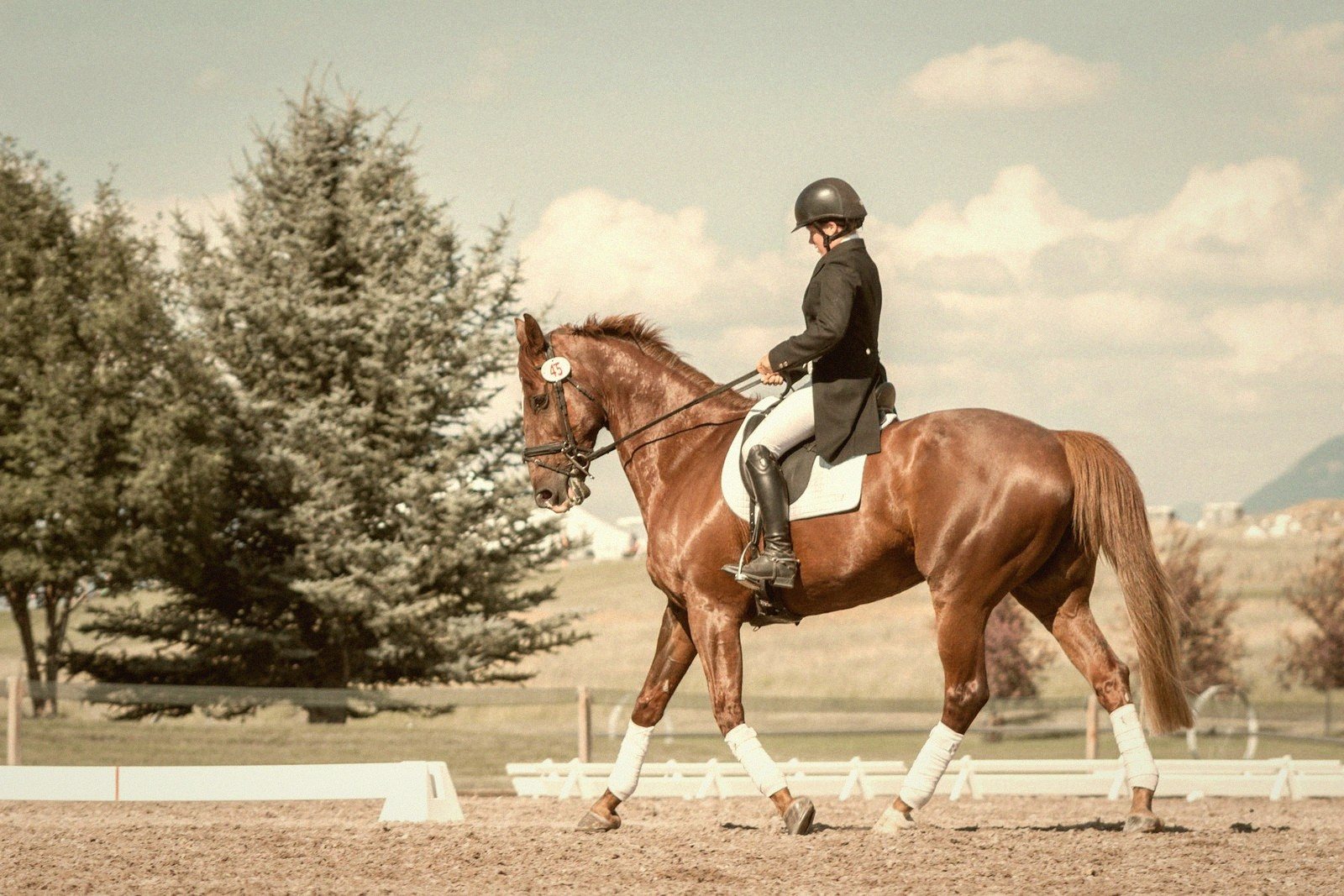
The letters around an arena look arbitrary — they're not. Understanding their logic turns a test from a memory exercise into a map.
§ 01Where the Letters Came From
Walk into any dressage arena and you'll find letters staked at seemingly random intervals around the rail: A, K, E, H, C, M, B, F — and, in a full-size arena, additional markers down the centre line and along the quarter lines. Ask a dozen coaches why they're placed where they are, and at least half will tell you nobody really knows. That's almost true — the precise origin is genuinely disputed — but the most credible explanation traces back to the royal stables of imperial Germany, where letters marked the stalls, tack rooms and equipment bays around the stable courtyard. When horses were trained in that courtyard, the letters stayed where they were. The convention passed into formal competition and stuck.
Whatever their ancestry, the letters are now internationally standardised by the Fédération Equestre Internationale (FEI). Every affiliated arena on earth shares the same arrangement. That consistency is the whole point: a test written in Germany rides identically in New Zealand.
§ 02The Layout, Logically
A standard dressage arena is 20 metres wide and 40 metres long — often called a small arena. The full, or large, arena extends to 20 by 60 metres and is used for most affiliated and all FEI-level competition.
In both sizes, A sits at the entry end (where you enter at the start of a test) and C sits directly opposite, at the judge's end. Those two are the anchors. The long sides carry E (left) and B (right), each positioned exactly halfway along the wall. K, F, M and H occupy the four corners of the short-arena perimeter; in the large arena, V, P, R and S extend the long sides further.
The centre line — the invisible axis running A to C — holds its own set of markers. D, L, X, I and G mark measured points along it; X sits exactly in the middle of any arena, at the intersection of the centre line and the E–B line. You never see a physical letter X at the rail. It exists purely as a reference point for movements performed in space, which is why it appears in almost every test: "circle at X," "halt at X," "medium trot from X."
A useful trick for memorising the letters in order around the small arena: A–K–E–H–C–M–B–F — the mnemonic "All King Edward's Horses Can Make Big Fences" has been doing quiet service for generations of riders.
A standard dressage arena is 20 metres wide and 40 metres long — often called a small arena.
§ 03Letters as Choreography
The real function of the letters is to convert written instructions into spatial precision. "Shoulder-in from K to H" doesn't mean "approximately halfway down that long side" — it means you establish the movement at the K marker and ride it through to H, with the quality and angle consistent throughout. The letters compress what would otherwise be paragraphs of description into a shared shorthand between test writers, judges and riders.
Judges sit at C, and often at B and E for higher-level tests, so those markers govern sight lines. A movement called at a specific letter is judged for preparation approaching it, quality through it, and transition away from it. Riding a circle "at B" means the circle is centred on B, touching the track at E. Geometry that drifts makes the error visible immediately against those fixed reference points.
This is why memorising a test by letter sequence — rather than by movement alone — matters. The letters are the skeleton. Get the scaffold right, and the movement has somewhere to live.