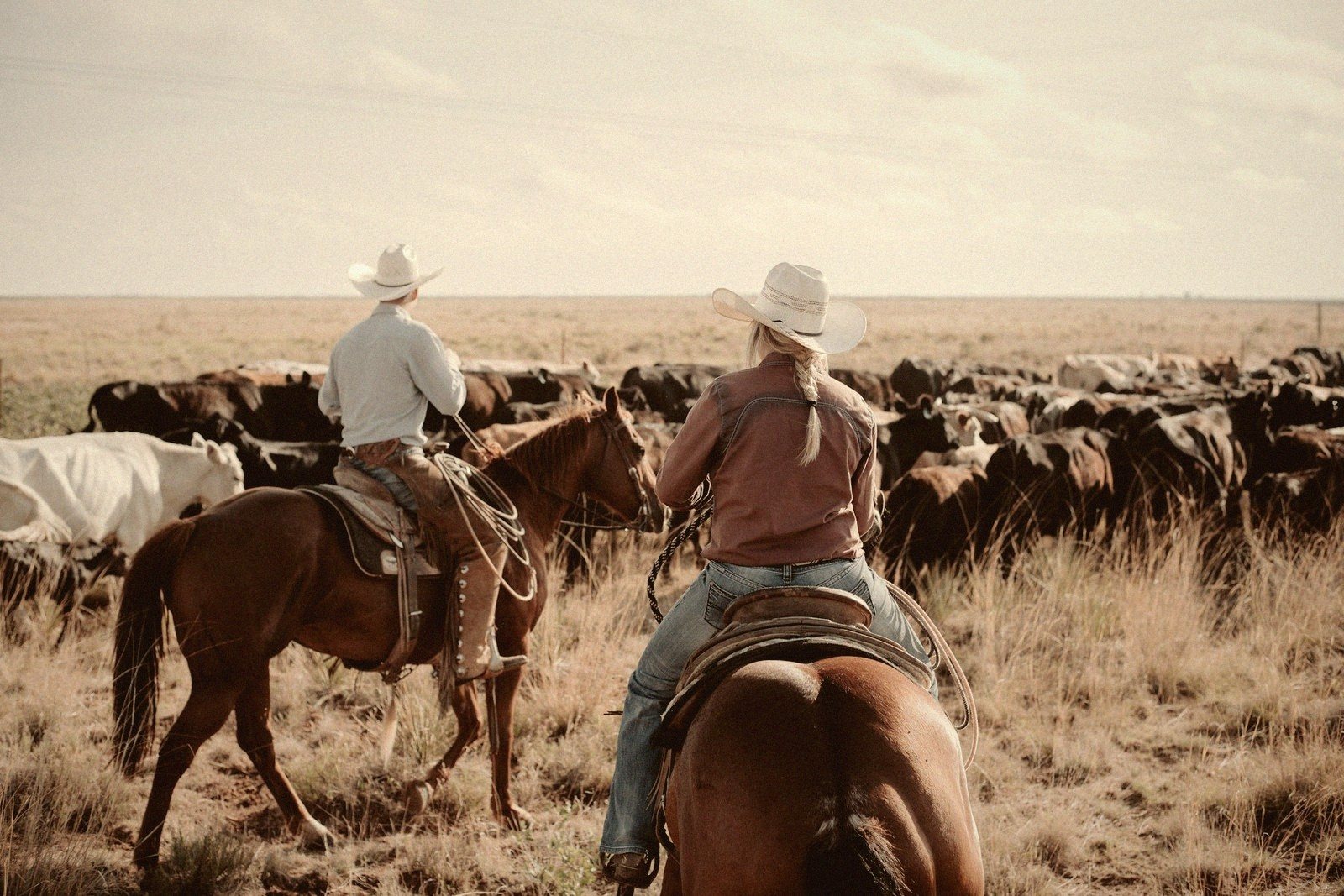
§ 01Sit differently, think differently — and discover what you already know
Swap your close-contact saddle for a western rig and the first thing you notice is the architecture. The deep seat, the high cantle, the prominent horn — it feels more like furniture than tack. That instinct to perch forward, built by years of two-point and rising trot, suddenly has nowhere to go. But the disorientation passes faster than most English riders expect, and what emerges on the other side is a genuinely useful education.
§ 02The Seat: Deeper, Not Lazier
The western position asks you to sit into the saddle rather than hovering above it. Weight drops into a long, relaxed leg with the heel down — familiar enough — but the hip angle opens, the lower back softens, and the upper body stacks vertically over the hip rather than inclining slightly forward as in a forward-seat discipline. Think collected dressage rider more than show jumper; the mechanics are closer than you'd imagine.
What catches English riders out is the impulse to grip. Years of security through thigh and knee don't serve you the same way in a western saddle; the seat itself provides stability, and gripping actively disrupts the fluid, following hip that the discipline rewards. The correction feels counterintuitive: relax more, not less. Once you stop fighting the saddle, the movement of a well-trained western horse — that flat, economical jog or the slow, three-beat lope — becomes surprisingly easy to sit.
§ 03Neck-Reining: Contact as a Foreign Language
This is where English muscle memory causes the most confusion. Direct reining — one rein to one side, steady contact, communication through feel — is replaced by neck-reining, in which a single hand carries both reins and the horse steers from lateral pressure on the neck rather than direct mouth contact. The rein moves toward the direction of the turn; the horse moves away from it.
Trained western horses go in a loose rein with near-zero contact as a baseline. For riders accustomed to bits working through a constant dialogue of give-and-take, riding in that slack feels like losing the radio signal. The temptation is to gather up and establish the familiar connection. Resist it. A well-schooled western horse reads your weight shift, your leg, and that light neck rein — contact in the English sense is not just unnecessary, it's interference.
Practice neck-reining on foot first if you can: hold the reins in one hand and simply move that hand left and right while feeling where pressure falls. The geometry becomes intuitive quickly, and you'll stop hunting for the other rein.
A well-schooled western horse reads your weight shift, your leg, and that light neck rein — contact in the English sense is not just unnecessary, it's interference.
§ 04What Transfers — More Than You Think
Here is the genuine surprise: a solid English foundation translates remarkably well. An independent seat is an independent seat. Feel in the hands — even if it manifests differently — is still feel. Spatial awareness, rhythm, the ability to read a horse's body through subtle postural shifts; none of that is discipline-specific. Riders who have put time into reading a horse's body language off the horse tend to adapt fastest, because they're already tuned to the signals that western horses broadcast through carriage and energy rather than through rein contact.
Balance is balance, too. The lope, which intimidates many first-timers, is actually easier to sit than a strong canter in an English saddle once you stop bracing. Leg yield, shoulder control, collection — the underlying biomechanics that western reining, cutting and horsemanship demand are genuinely sophisticated, and experienced English riders often grasp the logic faster than beginners starting from scratch.
§ 05The Point of Crossing Over
Riding western for a session or a season isn't about switching allegiances. It's about the recalibration. Sitting that deep seat strips away compensations; riding in a loose rein sharpens awareness of weight and leg; learning neck-reining makes your hands quieter back in your English bridle. Every serious rider who has crossed the divide comes back saying the same thing: the horse got clearer, because they had to get clearer first.