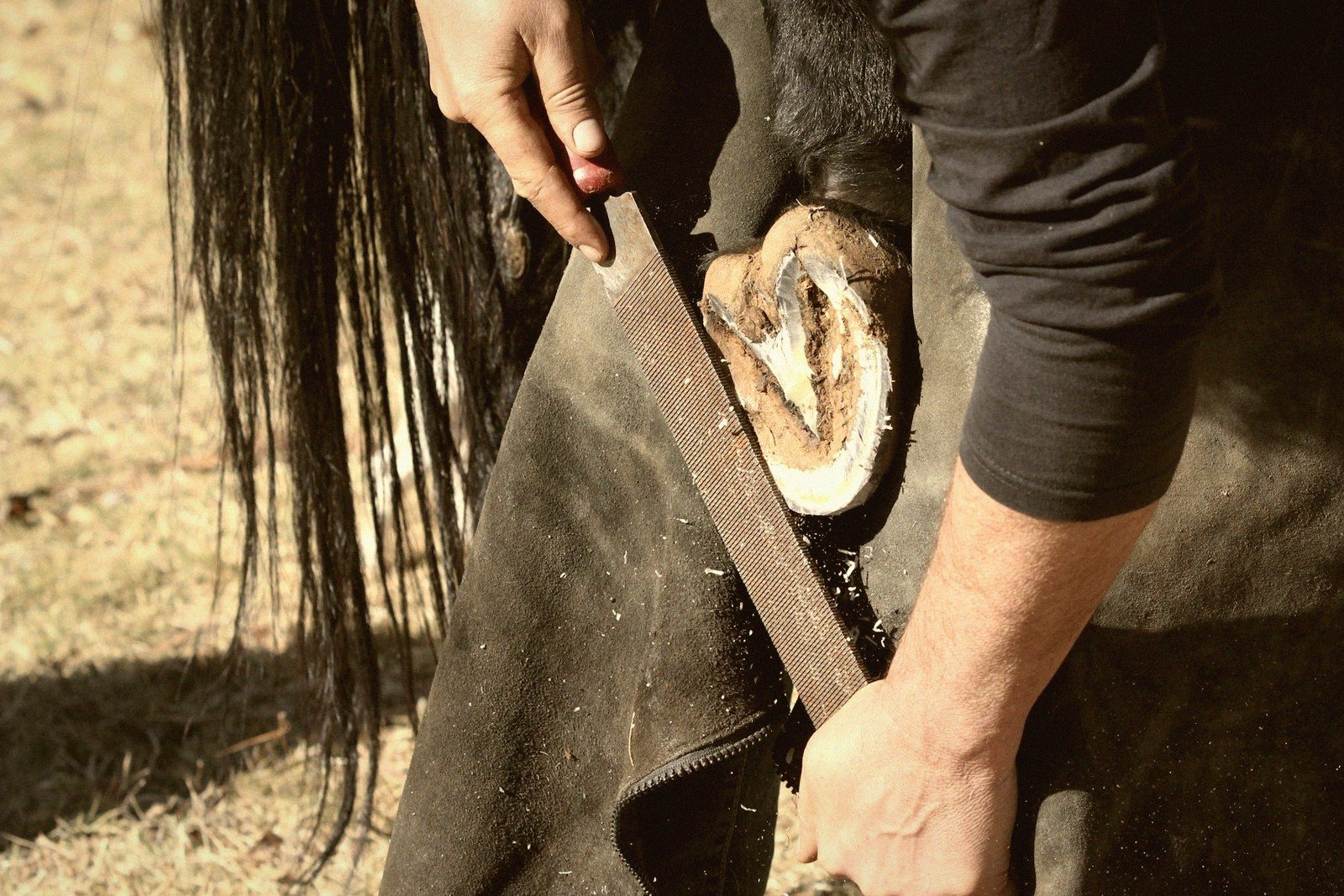
The hoof is not just a hard shell — it's a living, load-bearing structure that your farrier tends every six weeks, and that you should understand.
§ 01What You're Actually Looking At
Pick up a hoof and you hold an engineering marvel. The visible outer wall — the part that gets trimmed and shod — is only the beginning. Beneath it, a tightly integrated system of bones, connective tissue, blood vessels and a specialised structure called the laminae holds the horse together under forces that can exceed a tonne per stride.
The wall itself is made of keratin, the same protein as a human fingernail, and grows continuously from the coronary band — the soft, fleshy junction at the top of the hoof. Growth runs at roughly one centimetre per month, meaning a full replacement of the wall takes about a year. That slow clock is why neglect compounds: damage or imbalance introduced today won't be grown out until next autumn.
Underneath the horse, the sole forms the base of the hoof, slightly concave so that only its outer rim and the frog make ground contact under normal conditions. The frog — the rubbery, V-shaped wedge pointing toward the toe — is not decorative. It acts as a shock absorber, a traction aid, and a circulatory pump: as the horse's weight presses the frog into the ground, blood is actively squeezed back up the leg. A frog that's trimmed too aggressively or chronically contracted from lack of movement stops doing its job, and the effects travel upward.
Deep inside, the coffin bone (the third phalanx) sits within the hoof capsule, suspended by the interlocking laminae — thousands of microscopic leaf-like projections that bond the bone to the inner wall. This bond is what fails catastrophically in laminitis, when inflammation severs the connection and allows the bone to rotate or sink under the horse's weight. It's why laminitis can become a life-limiting or life-ending condition; the architecture that seems so solid is maintained by tissue no thicker than a few millimetres.
§ 02The Farrier's Cycle
Most horses need their feet attended to every six to eight weeks, shod horses and barefoot horses alike. Left to grow unchecked, the wall flares outward, the toe lengthens, the angle of the coffin bone shifts, and uneven loading begins to stress the tendons and joints above. The old saying — no foot, no horse — is not hyperbole.
At each visit, a farrier assesses the foot before touching it. They watch the horse move, looking at how each hoof breaks over at the toe, whether one foot lands differently from another, and whether the wear pattern on an old shoe reveals anything about imbalance. This is skilled diagnostic work, not just metalwork.
Trimming restores the correct angle between the hoof and the ground — typically 45 to 55 degrees at the front feet, slightly steeper at the hinds — and brings the length back in balance. On a shod horse, old shoes are pulled, the foot is trimmed and rasped level, and new shoes are fitted. A well-fitted shoe follows the white line (the narrow pale band visible on the sole where wall meets inner structure), is nailed through the wall only, and provides even support around the foot.
Whether to shoe at all depends on the individual. Barefoot horses, if managed correctly, can develop a tougher, more concave sole and a wider, more functional frog than many shod horses. The hoof wall thickens and hardens with conditioning on varied terrain. But the transition takes months and isn't right for every horse on every surface — a horse in regular road work or competing on hard ground often genuinely needs the protection and grip a shoe provides. It is not an either/or ideology; it's a decision made foot by foot, horse by horse, in conversation with your farrier.
Trimming restores the correct angle between the hoof and the ground — typically 45 to 55 degrees at the front feet, slightly steeper at the hinds — and brings the length back in balance.
§ 03What Healthy Looks Like
You don't need to be a farrier to do a daily visual check, and you should. A healthy hoof grows evenly from the coronary band, with no rings, bulges or indentations running around the wall. Rings can indicate a period of nutritional change or illness; founder rings — deep, uneven grooves wider at the heel than the toe — are a specific warning sign of past laminitic episodes.
The frog should be firm and roughly symmetrical, free from deep central grooves or black, soft, foul-smelling tissue (signs of thrush, a bacterial infection that thrives in wet, dirty conditions). The white line, visible when the foot is cleaned out, should appear tight and pale; a stretched, widened or crumbly white line suggests white line disease or past rotation of the coffin bone.
Warmth and digital pulse are your physiological gauges. Mild warmth in the wall is normal after work; heat that persists, or a bounding pulse felt at the back of the fetlock, demands attention before that horse moves another step.
Your farrier is your first point of call for anything that concerns you — before the vet, in many cases. That six-week cycle is not an optional appointment. It is the infrastructure of a sound horse.
§ 04From the field notes
General guidance for owners and riders — not veterinary advice. For anything beyond everyday husbandry, involve your own vet or farrier.