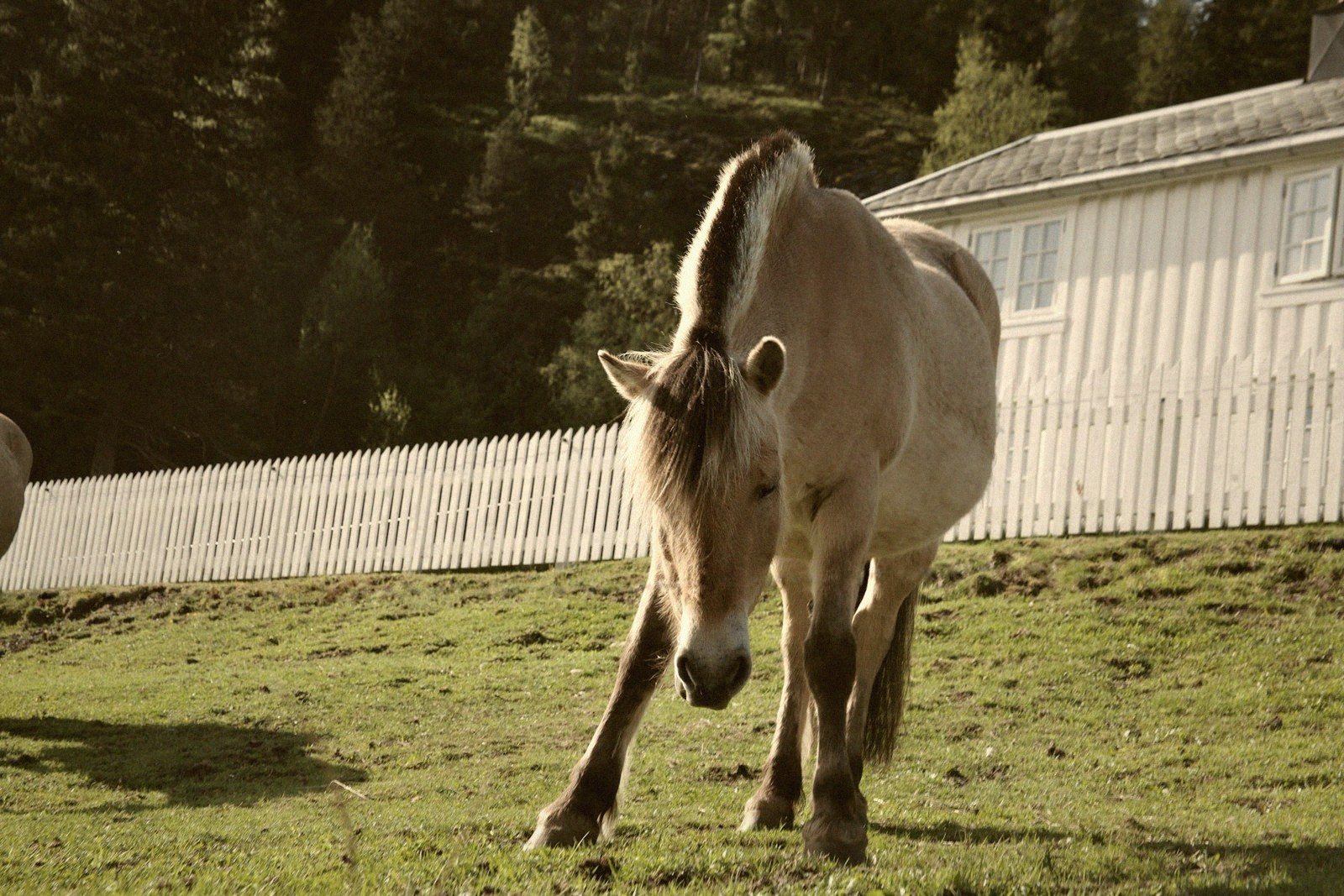
One of the oldest and purest breeds in existence, the Norwegian Fjord is small in stature, enormous in mind, and utterly distinctive in appearance.
§ 01Carved by Scandinavia
The Norwegian Fjord horse is among the few breeds that can claim genuine antiquity without stretching the evidence. Archaeological findings in Norway suggest the breed has been domesticated for more than four thousand years, and the wild ancestors of today's Fjord appear in Viking Age carvings and burial sites. Unlike many ancient breeds diluted by crossbreeding over the centuries, the Fjord has remained remarkably pure — a product of deliberate selection in a hard landscape where only the genuinely useful survived.
The result is a horse that reads, at first glance, almost like a draft pony: compact and muscular, standing between 13.2 and 15 hands, with a broad forehead, wide-set eyes, and substantial bone. But the Fjord moves with a lightness that surprises people who expect something plodding. The topline is strong, the hindquarters well-rounded, and the gaits — when the horse is working correctly — have genuine impulsion. This is a horse built to carry weight up steep terrain, pull a load through snow, and still be responsive enough to manage on a loose rein.
The colour is one of the breed's most recognisable features. All Fjords are dun — most a brown dun called brunblakk, though the breed standard also recognises grey dun (grå), red dun (rødblakk), yellow dun (gulblakk), and the striking pale white dun ( ulsblakk ). Every Fjord carries the primitive dun markings: a dark dorsal stripe running from forelock to tail, zebra barring on the legs, and sometimes a transverse stripe across the withers. These are the hallmarks of ancient equine genetics, shared with Przewalski's horse and the Tarpan.
The mane is perhaps the most theatrical detail. Traditionally roached in a crescent cut that follows the curve of the neck, the outer edges are cut shorter to reveal the dark central stripe framed by lighter outer hair. In Norway, this cut is not merely tradition — it is breed standard. A Fjord with a long, flowing mane is, technically speaking, incorrectly presented.
These are horses described consistently — by breeders, trainers, and owners across very different disciplines — as thoughtful rather than reactive.
§ 02A Mind Worth Talking About
The Fjord's temperament is where the breed earns its most loyal following. These are horses described consistently — by breeders, trainers, and owners across very different disciplines — as thoughtful rather than reactive. They are not dull. Dullness is a different thing: a horse that ignores input because it has learned not to engage. The Fjord engages, fully, but it processes before it responds. New situations are examined, assessed, and usually accepted rather than fled from. That quality makes them genuinely forgiving for less experienced riders, yet interesting enough not to bore a skilled one.
They are also honest about discomfort. A Fjord that pins its ears or stiffens through a movement is telling you something specific — about saddle fit, about pain, about a training ask that doesn't make sense to it yet. Owners who learn to listen to that feedback tend to find the relationship with a Fjord unusually communicative. Those who override it discover a horse with a long memory and a firm sense of what it considers fair.
In practical terms, the breed covers a remarkable range of disciplines. In Scandinavia, combined driving remains deeply traditional, and the Fjord excels — the combination of pulling power, calm disposition, and precision response suits the sport well. But Fjords also compete in dressage, trek over mountain trails, serve in therapeutic riding programmes, and carry children reliably for years before moving seamlessly to adult riders. They are genuinely dual-purpose in a way few breeds manage: robust enough for work, sensitive enough for refinement.
They are also economical to keep. Good doers in the truest sense, Fjords maintain condition on modest forage, winter well, and tend toward health rather than fragility. The trade-off — one familiar to owners of any easy keeper — is vigilance around laminitis risk, particularly on spring grass. Weight management requires attention.
What the Fjord offers in return is a horse that is, in almost every practical sense, ready. Ready to work, ready to think, ready to try. That reliability, worn lightly and without drama, is rarer than it looks.