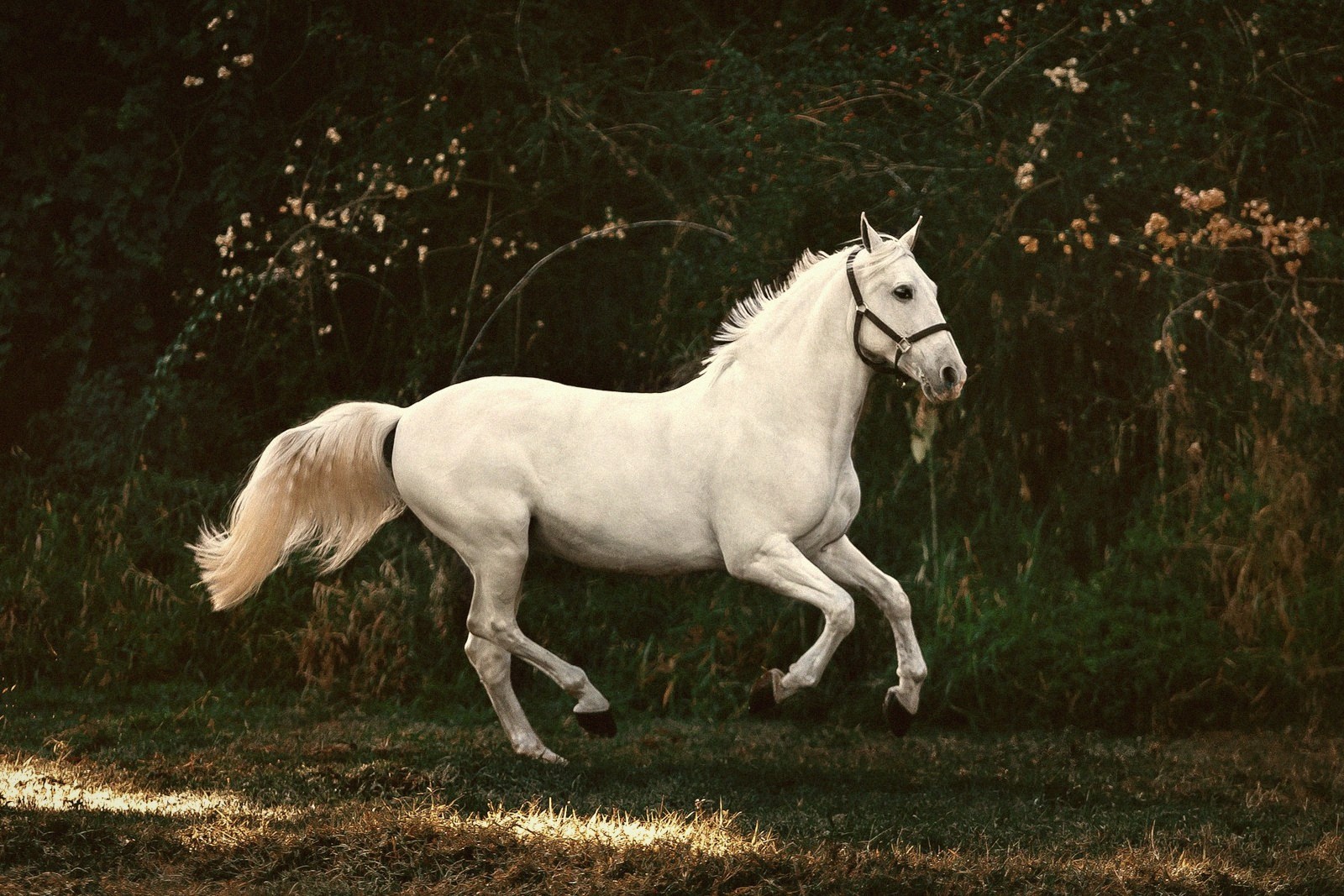
Dished face, high tail, and the stamina that founded half the world's breeds.
§ 01Born of the Desert
No breed carries a longer, better-documented history than the Arabian. For at least 2,500 years — and almost certainly longer — the Bedouin tribes of the Arabian Peninsula bred these horses with extraordinary care, keeping oral genealogies and selecting ruthlessly for soundness, intelligence and the ability to travel vast distances on minimal feed and water. The desert did the rest. Heat, sparse forage and total dependence on the horse as a survival tool created an animal of remarkable physical efficiency: a compact, dry-boned horse with dense hooves, a broad forehead housing large sinuses, and an unusually large lung and heart capacity relative to body size.
The physical signature is unmistakable. The dished — concave — facial profile, the wide-set, dark, expressive eyes, the fine-skinned muzzle, and the high tail carriage set the Arabian apart at a glance. Beneath the skin, the breed often carries a structural quirk: most Arabians have 17 pairs of ribs, five lumbar vertebrae and 16 tail vertebrae, compared to the 18, 6 and 18 typical of other breeds. Whether that skeletal difference directly explains their short-backed strength is debated, but the compact coupling is real and functional.
Coat colour is limited — grey, bay, chestnut and black are the only permissible colours in most registries, with no white markings above the knee accepted from the body (though grey is by far the most common in the breed as a whole). The skin beneath is dark regardless of coat colour, an adaptation that prevents sunburn and is visible where the coat is fine at the muzzle and around the eyes.
§ 02Founder of Breeds
The Arabian's influence on other breeds is without parallel. When Charles II imported Arabians to Britain in the seventeenth century and the English Thoroughbred was formalised through three founding stallions — the Byerley Turk, the Darley Arabian and the Godolphin Arabian — the Arabian's speed and refinement were baked permanently into the world's dominant racing breed. The Thoroughbred carried that influence forward into virtually every European warmblood studbook; trace almost any modern sport horse's pedigree far enough and you arrive at Arab blood.
The reach extends well beyond Europe. The Standardbred, the Morgan, the American Quarter Horse, the Lipizzaner — all carry Arabian ancestry in varying concentrations. In the Polish national studs at Janów Podlaski and Białka, selective breeding has produced a distinct Polish Arabian line, renowned internationally and the subject of annual elite auctions. Crabbet Park in England, established in the nineteenth century by Lady Anne Blunt and Wilfrid Scawen Blunt, became one of the most influential Arabian breeding programmes outside the Arabian Peninsula, with Crabbet bloodlines still traceable in British and American horses today.
The dished — concave — facial profile, the wide-set, dark, expressive eyes, the fine-skinned muzzle, and the high tail carriage set the Arabian apart at a glance.
§ 03The Endurance Engine in Practice
The Arabian's modern reputation rests most firmly on endurance riding, and the evidence is overwhelming. At the Tevis Cup — the 100-mile ride through the Sierra Nevada mountains that is the sport's most gruelling one-day event — Arabians and part-Arabians dominate the completion and placing lists year after year. The breed's efficient metabolism, its ability to dissipate heat, and its naturally lower resting heart rate and fast cardiac recovery give it a measurable physiological advantage over most other breeds across prolonged, sustained effort.
That same economy of movement and cardiovascular efficiency translates well to other disciplines. Arabians compete in dressage, show jumping and showing, though at elite levels in the first two they face stiff competition from purpose-bred warmbloods. Where they consistently excel in the show ring is in Arabian-specific halter and performance classes, where type, movement quality and presence are paramount.
Temperamentally, the breed warrants honest description. Arabians are highly intelligent, sensitive and quick to learn — which means they amplify the rider. In calm, sympathetic hands they are willing and responsive; in inconsistent or harsh hands, the same sensitivity produces anxiety and reactive behaviour. They are not a breed that tolerates confusion well. For experienced riders who meet that intelligence with clarity, the Arabian's engagement and try are remarkable.
§ 04A Living Blueprint
What the Bedouin understood intuitively, modern genetics confirms: the Arabian is among the least genetically diverse of domesticated horse breeds, the product of a closed, carefully managed gene pool sustained over millennia. That bottleneck brings known health concerns — cerebellar abiotrophy, lavender foal syndrome and severe combined immunodeficiency are all autosomal recessive conditions present in the breed — and responsible breeders now test for carrier status.
None of that diminishes the achievement the breed represents. The Arabian is a living blueprint: the template from which modern horse sport was largely built, still performing at the sharp end of the most demanding discipline equestrian sport has produced.