The heavy breeds that moved freight, ploughed fields, and built cities — and why they matter far beyond the era of the workhorse.
§ 01Bred for the Weight of the World
Before the combustion engine, heavy horses were infrastructure. They hauled coal from pit heads, dragged ploughs through clay soils, pulled brewery drays through city streets, and moved artillery across battlefields. The three breeds that dominated this work — the Shire, the Clydesdale, and the Percheron — each emerged from distinct geography and specific human need, and each solved the problem of raw power in a subtly different way.
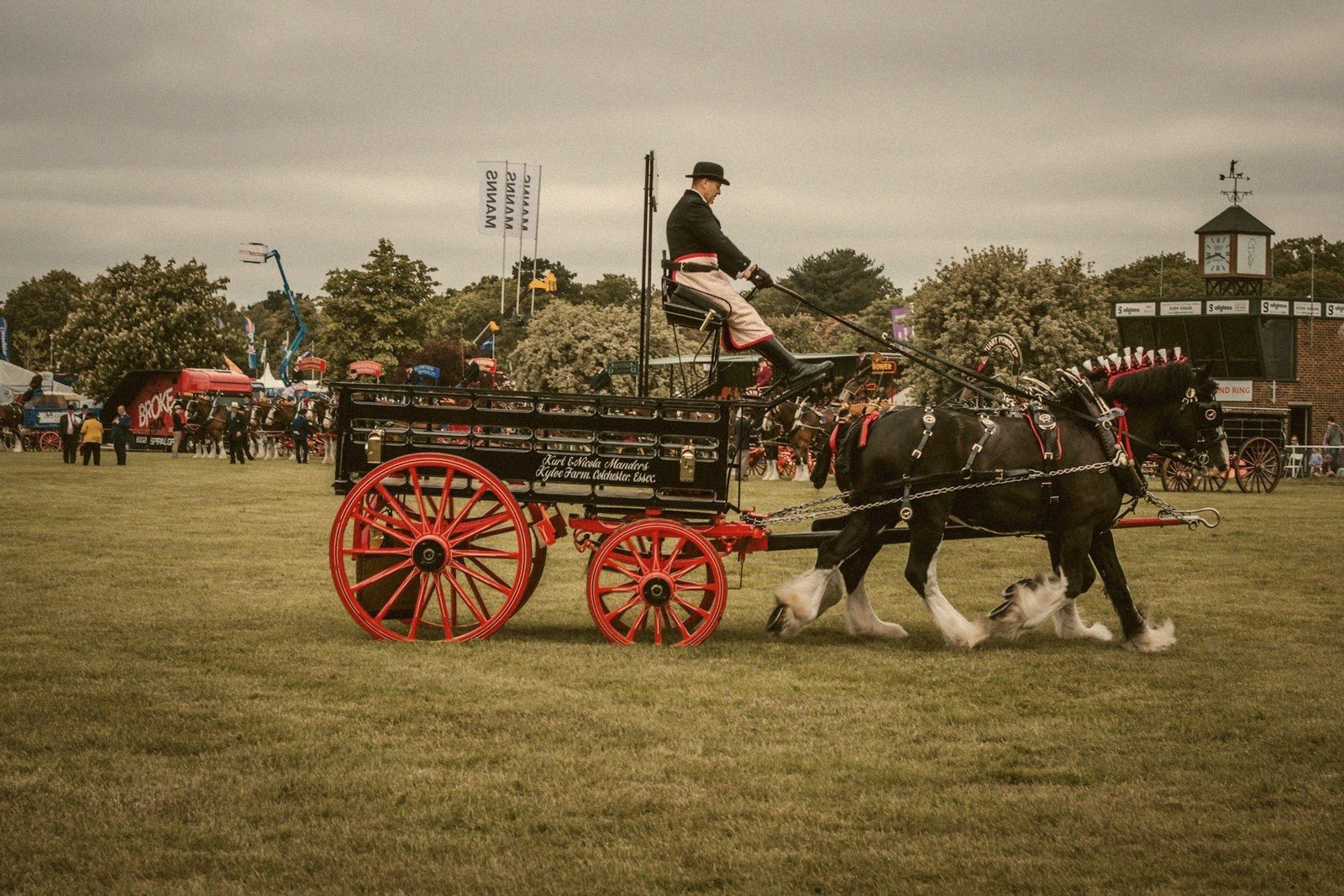
The Shire is the quintessential English heavy horse, bred in the Midland counties of Lincolnshire, Derbyshire and Staffordshire from at least the sixteenth century, with formal breed society records dating to 1878. It is the tallest of the three, routinely standing between 16.2 and 18 hands, and the Shire holds claims to the heaviest recorded horses in history — animals exceeding a tonne. What strikes people first is the feathering: the long, silky hair that cascades from knee and hock to hoof. What strikes them second, usually, is the temperament. For an animal of this scale, the Shire is remarkably calm — curious, biddable, and slow to startle.
The Clydesdale came out of Lanarkshire, Scotland, developed through the eighteenth century by crossing local mares with Flemish stallions. Where the Shire is broad and deep-bodied, the Clydesdale is slightly more upstanding, with an active, high-stepping action that made it particularly valued on hard city roads. Its feathering is similarly abundant. The breed spread rapidly through the British Empire — Australia and New Zealand imported thousands — and at the peak of agricultural horse power in the early twentieth century, Clydesdale numbers in Britain alone ran into the hundreds of thousands. The Clydesdale Horse Society, founded in 1877, remains the oldest active heavy horse breed society in the world.
The Percheron tells a different story. Originating in the Perche region of Normandy, France, it carries a traceable influence of Arabian and Oriental blood introduced through the medieval trade routes and, later, deliberately crossed in during the eighteenth century. The result is a horse that looks like no other draft breed: refined head, arched neck, and clean legs with minimal feathering. Percherons are almost always grey or black. They move with a lightness unusual for their mass — typically 16 to 18 hands — and were prized in France as coach horses before their agricultural role eclipsed everything else. American importers brought large numbers across the Atlantic from the 1850s onward, and the Percheron became the dominant farm horse of the United States Midwest, well suited to the heavy prairie soils.
Draft breeds were selected over centuries not only for strength but for the ability to stand quietly in noise, traffic, and crowd — a working horse that spooked was a dangerous horse.
§ 02After the Tractor — and Now
The arrival of mechanised farming after the Second World War nearly ended all three breeds. Shire numbers in Britain collapsed to only a few thousand by the 1960s; the breed appeared on conservation watchlists. The Clydesdale and Percheron fared similarly across their home nations. What saved them was a combination of enthusiast societies, showing culture, and — unexpectedly — commerce. The Budweiser Clydesdales, introduced as a promotional team in the United States in 1933, kept the breed visible to tens of millions of people who would never attend a county show. Brewery drays pulled by Shires became a marketing feature rather than a logistics necessity. Showing and ploughing competitions preserved working skills that might otherwise have vanished entirely.
Today all three breeds are more stable, though the Shire remains on the Rare Breeds Survival Trust's watchlist in the United Kingdom. Their roles have diversified: forestry operations in sensitive woodland, where wheeled machinery causes damaging compaction, increasingly return to horse-drawn extraction. Small-scale organic farms use them as a genuine alternative to diesel. And riding — particularly driving and pleasure riding — has introduced draft horses to owners who value their steadiness above almost anything else.
That steadiness is worth examining seriously. Draft breeds were selected over centuries not only for strength but for the ability to stand quietly in noise, traffic, and crowd — a working horse that spooked was a dangerous horse. The result is a type that tends toward patience and tolerance in ways that catch new owners off-guard. They are big, yes, emphatically so. But the working draft horse earns the word gentle just as honestly as it earns giant.